
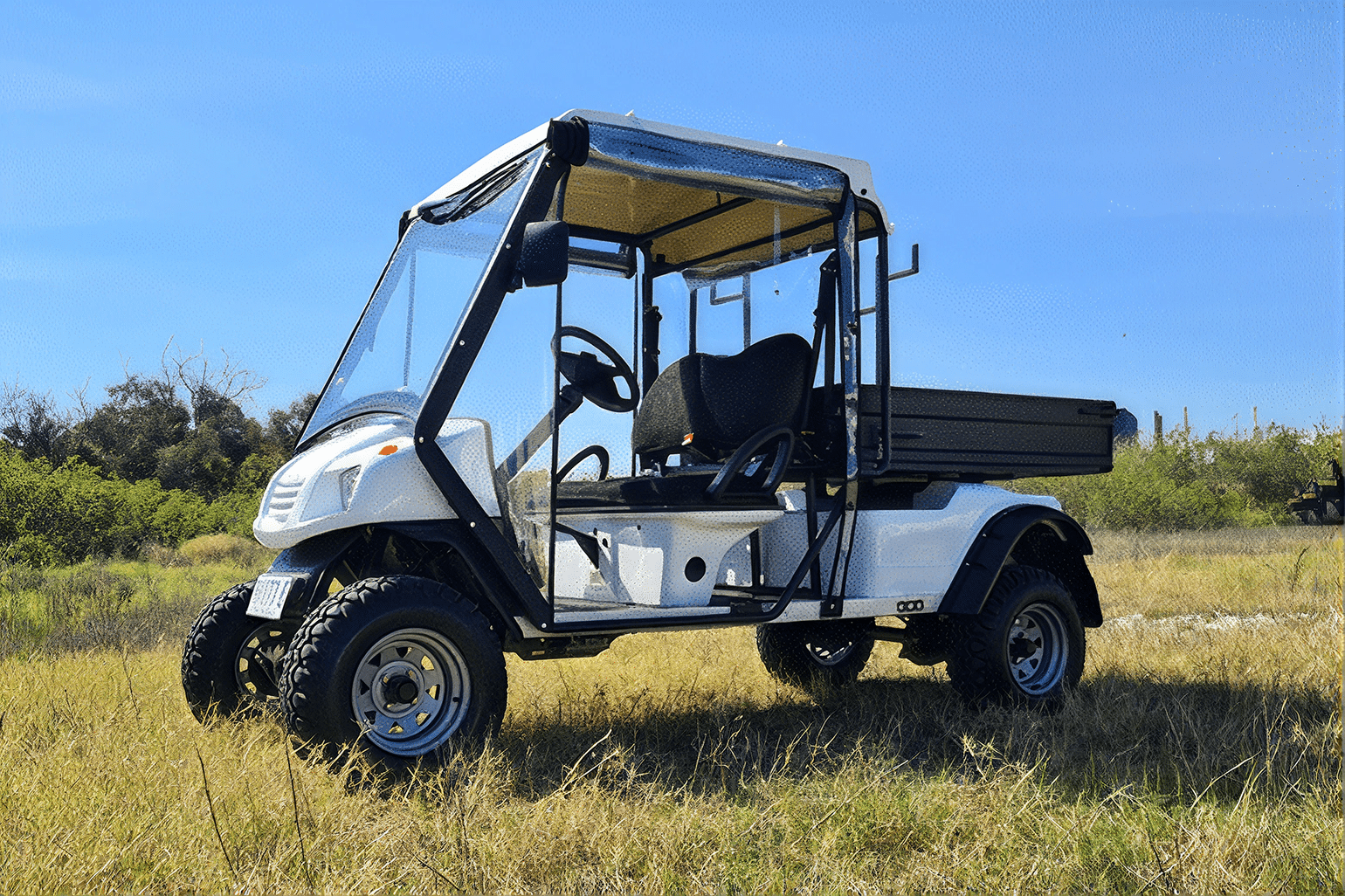
Choosing between electric utility vehicles for a hospital, campus, or council site sounds simple until you sit down with a spec sheet. Payload, towing, range, terrain, charging: the numbers all look important, and it is hard to know which ones matter for your site. Get it wrong, and you overpay for capability you never use, or end up with a vehicle that struggles once loaded or driven across gravel.
Key points
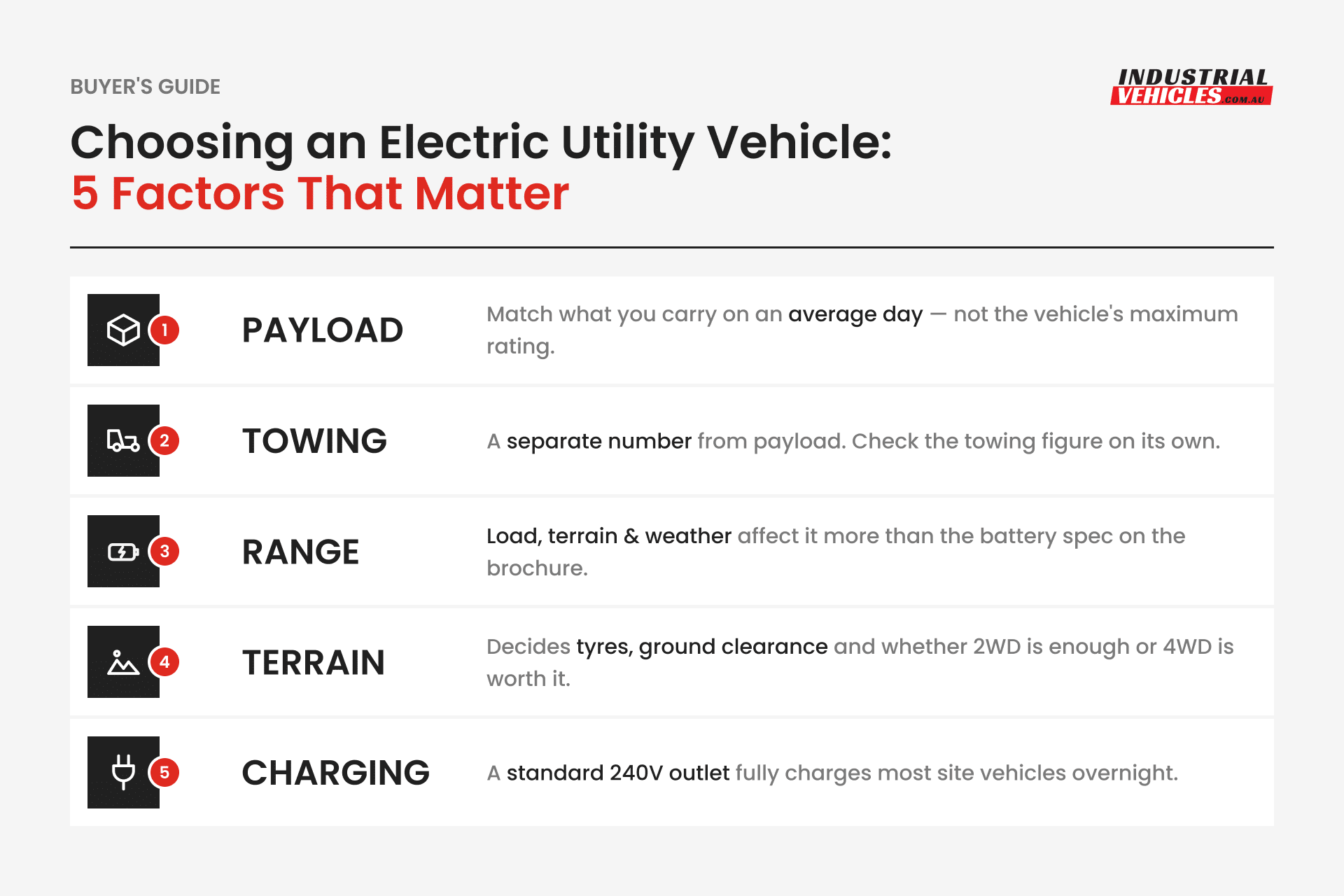
- Payload capacity should match what you carry on an average day, not the vehicle’s maximum rating.
- Payload and towing capacity are separate numbers, and confusing them is a common buying mistake.
- Range depends more on load, terrain, and temperature than the battery figure on a brochure.
- Most facilities vehicles charge comfortably from a standard power outlet overnight.
- Terrain decides tyre choice, ground clearance, and whether 2WD is enough or 4WD is worth it.
1. How Much Weight Does It Actually Need to Carry?
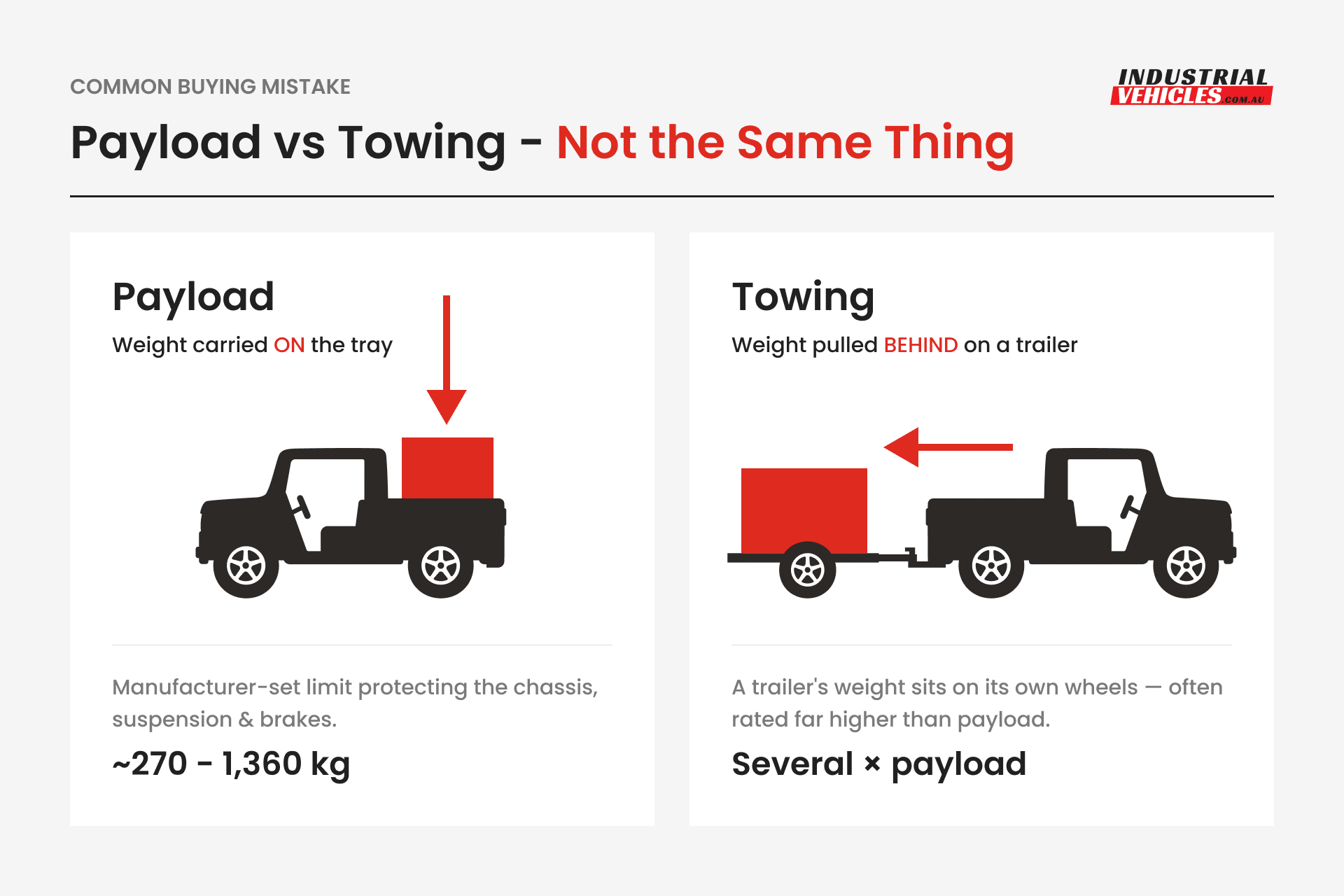
Payload capacity is the maximum weight a vehicle can safely carry within its own structure, set by the manufacturer to protect the chassis, suspension, and brakes rather than as a marketing figure. Published ratings commonly range from around 270 kilograms on compact models to 1,360 kilograms or more on heavier-duty carriers.
Think about a normal shift rather than a worst case. A housekeeping trolley run is very different from an occasional pallet move, and buying for the rare heavy day means paying for capacity that sits unused the rest of the time. Our range of electric utility vehicles spans compact carriers through to heavier tray configurations, so match the model to your typical load.
2. Payload and Towing Are Not the Same Thing
It is easy to assume a vehicle rated for a heavy tow can also carry that weight on its tray. It usually cannot. Personnel carriers are often rated for a few hundred kilograms of payload but several times that in towing, since a trailer’s weight sits on its own wheels. If your site pulls waste bins or equipment trailers, check the towing figure on its own rather than assuming it scales with payload.
3. Range: How Far Will You Really Drive?
Range anxiety matters less for site vehicles than people expect. Most facilities’ driving is short, repeated loops, so daily distance is usually a small fraction of a vehicle’s rated range. Load, terrain, and weather change real-world range more than the brochure figure. Cold conditions alone can cut usable battery capacity by 20 to 40 percent, and a loaded tray or a hilly site drains a battery faster than a flat, empty run. Ask what conditions a range figure was tested under, not just the headline number.
4. Terrain and Where the Vehicle Will Operate
Terrain often decides whether a vehicle performs well or struggles daily. Smooth internal floors call for different tyres and clearance than gravel paths, ramps, or mixed grounds. Paved sites suit standard 2WD models, while slopes, unsealed paths, or weather exposure benefit from 4WD and greater clearance. Indoor use adds its own needs: non-marking tyres to protect floors, and quiet running for wards or offices.
5. Charging Access on Your Site
Charging tends to be simpler than facilities managers expect. A standard 240V power outlet fully charges most site vehicles overnight, since daily distances sit well within what trickle charging can replace. A dedicated fast charger is rarely needed for fleets that return to base each night, though it can help sites running vehicles across multiple shifts.
Choosing With Confidence
The right electric utility vehicle is matched to your loads, your terrain, and your charging routine, not the model with the biggest numbers on paper. Our team can help you weigh up electric utility vehicle options against your site conditions and load requirements, so you land on a vehicle that performs from day one. Contact us for a tailored recommendation.
Frequently Asked Questions
1. What’s the difference between payload and towing capacity?
Payload is the weight a vehicle carries on its own tray. Towing capacity is what it can pull on a trailer. The two are rated separately, and one does not indicate the other.
2. How far can an electric utility vehicle travel on a single charge?
Ranges vary by model, with personnel carriers often rated around 20 miles and burden carriers up to 60 miles under standard conditions. Real-world range is lower with heavy loads, hills, or cold weather.
3. Do I need a special charger installed?
Not usually. A standard power outlet can fully charge most site vehicles overnight. Multi-shift fleets may benefit from a dedicated charger for faster turnaround.
4. Can these vehicles be used indoors and outdoors?
Yes, many models suit both. Indoor use calls for non-marking tyres and quiet running, while outdoor sites may need greater clearance or 4WD depending on terrain.
5. How does terrain affect which vehicle I should choose?
Terrain determines tyre type, clearance, and drivetrain. Paved sites suit standard 2WD models, while sloped or weather-exposed grounds perform better with 4WD.
